 how-to
What Happens During a Mortgage Home Appraisal
Table of Contents
- Why Lenders Require a Home Appraisal
- When the Home Appraisal Happens During Purchase
- How Long Does a Home Appraisal Take
- What Does a Home Appraiser Look For During the Visit
- How Comparable Properties Determine Your Home's Value
- Home Appraisal Checklist for Buyers
- What Appraisers Do Not Evaluate
- Low Home Appraisal Options and Next Steps
- Frequently Asked Questions
Last Updated: October 20, 2026
Why Lenders Require a Home Appraisal
A home appraisal is an independent assessment of your property's fair market value. Lenders require one because they need to know what the home is actually worth before they approve your loan. This protects both you and the lender.
Think of it this way: if you're borrowing $300,000 to buy a house, the lender wants to confirm the house is worth at least that much.
The appraisal process also protects you. It prevents you from overpaying for a property or getting locked into a bad deal. If the appraised value comes in lower than your purchase price, you have options to renegotiate or walk away.
At The Modern Lending Group, we work with appraisers throughout the mortgage process to ensure your property valuation is accurate and fair. This step is non-negotiable for any mortgage approval, whether you're a first-time buyer or refinancing an existing loan.
When the Home Appraisal Happens During Purchase
The appraisal typically happens after your offer is accepted but before your loan closes. Here's the general timeline:
- You make an offer on a home and it's accepted
- You get a mortgage pre-approval (or move forward with your lender)
- Your lender orders the appraisal (usually within 3-5 days of acceptance)
- The appraiser schedules a site visit (typically 7-14 days after the order)
- The appraisal report is completed (usually 3-5 business days after the visit)
- Your lender reviews the report and decides on loan approval
The entire process usually takes 2-3 weeks from start to finish. Timing matters because your closing date depends on the appraisal being complete and acceptable to your lender.
If the appraisal comes back lower than your purchase price, you'll need time to work through options with your lender and the seller. This is why getting the appraisal done early in the closing timeline is important, it gives everyone time to respond if there's a problem.
How Long Does a Home Appraisal Take
The appraisal itself has several time components:
The site visit: 30 minutes to 2 hours, depending on the home's size and complexity. A small condo takes less time than a 5-bedroom house on a large lot.
Report preparation: 3-5 business days after the visit. The appraiser needs time to research comparable sales, compile photos and measurements, and write the formal report.
Lender review: 1-2 business days. Your lender reviews the report to make sure it supports the loan amount.
Total timeline: 2-3 weeks from the time your lender orders the appraisal to when you have a final decision.
Delays can happen. If the appraiser has a heavy workload, scheduling might take longer. If the appraisal comes back with issues, your lender might order a second opinion, which adds another 1-2 weeks.
What Does a Home Appraiser Look For During the Visit
When the appraiser arrives, they're evaluating dozens of factors that affect the home's value. They're not just looking at whether the house is clean, they're assessing structural condition, improvements, location, and how it compares to similar homes nearby.
Interior Inspection and Property Condition
The appraiser walks through every room and notes the condition of major systems and finishes. They check:
- Roof condition (age, wear, remaining life expectancy)
- HVAC system (heating and cooling equipment type and age)
- Plumbing and electrical (updated or outdated, any visible issues)
- Foundation and structural integrity (cracks, settling, water damage)
- Walls, ceilings, and flooring (condition, updates, wear)
- Appliances (age, working condition, included in sale)
- Bathrooms and kitchen (updated fixtures, countertops, cabinets)
- Interior walls and paint (cosmetic condition)
The appraiser is looking for deferred maintenance, problems that haven't been fixed. A 30-year-old roof that's still functional but near the end of its life will lower the value. A foundation crack might signal a serious structural issue.
Upgrades matter too. A newly renovated kitchen adds value. Updated electrical and plumbing systems are worth more than old ones. The appraiser documents these improvements because they directly affect what a buyer would pay.
Exterior Features and Site Assessment
The outside of the property is just as important as the inside. The appraiser evaluates:
- Roof condition (shingles, metal, slate, age and wear)
- Siding and exterior walls (brick, vinyl, wood, condition)
- Lot size and shape (square footage, usability, landscaping)
- Driveway and parking (paved, gravel, condition)
- Deck or patio (materials, condition, size)
- Fence or boundary lines (condition, encroachments)
- Neighborhood conditions (nearby properties, traffic, noise, commercial vs. residential)
- Site accessibility (corner lot, cul-de-sac, road frontage)
A large, well-maintained lot in a quiet neighborhood adds value. A small lot on a busy street reduces it. The appraiser also notes environmental factors, proximity to schools, parks, shopping, and public transportation all matter.
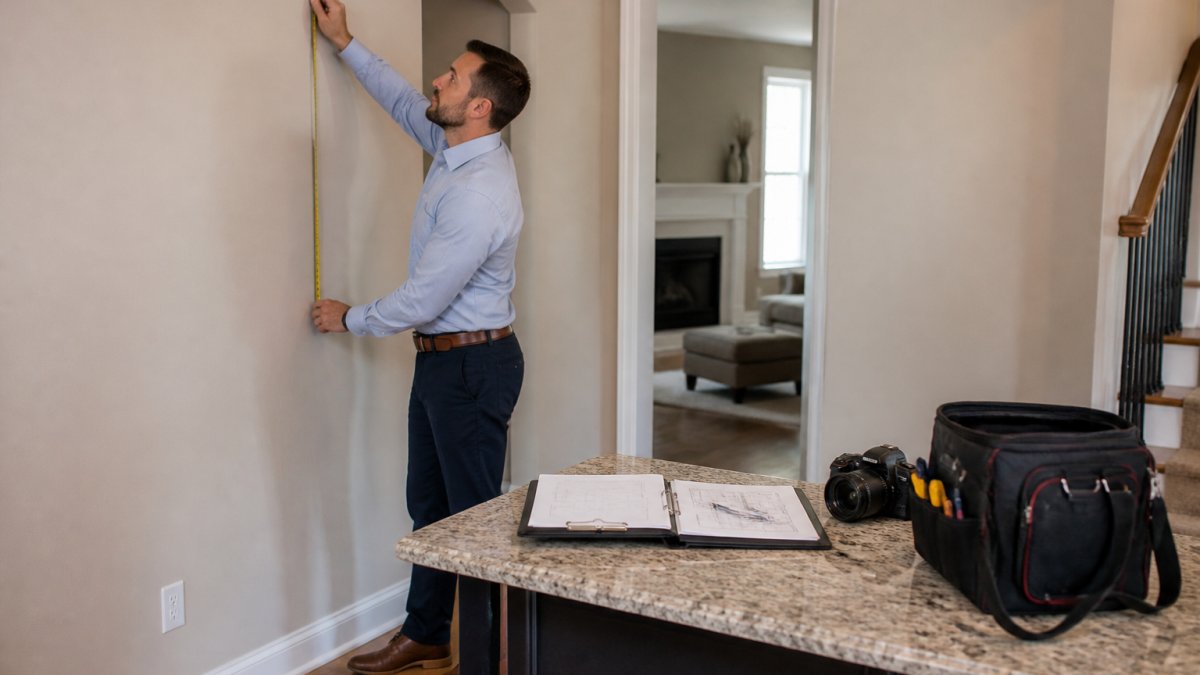
Measurements, Photos, and Documentation
The appraiser takes precise measurements of the home's square footage. They photograph:
- Every room in the house
- The exterior from multiple angles
- The lot and surrounding area
- Any damage, wear, or notable features
These photos and measurements go into the appraisal report. They serve as documentation of the property's condition on the appraisal date. If there's ever a dispute about the valuation, these photos and notes are evidence of what the appraiser actually saw.
The appraiser also collects public records data, property tax records, deed information, and any permits for recent work done on the home.
How Comparable Properties Determine Your Home's Value
The appraiser doesn't just walk around and guess a value. They use the sales comparison approach, which means they find similar homes that sold recently in your area and use those sales to estimate your home's value.
Here's how it works:
- The appraiser identifies comparable properties (usually 3-5 homes that sold within the last 90 days in your neighborhood)
- They adjust for differences (if a comparable home is 500 square feet smaller, they add value; if it has an extra garage, they subtract)
- They calculate an average value based on the adjusted comparable sales
- They cross-reference with other valuation methods (cost approach, income approach if applicable)
The comparable properties need to be genuinely similar, same neighborhood, similar size, similar age, similar condition. A luxury home in the next town over doesn't help value a modest ranch in your area.
Recent sales matter most. A home that sold 6 months ago is more relevant than one that sold 2 years ago. Market conditions change. If home prices in your area have been rising, older sales might undervalue the property.
Home Appraisal Checklist for Buyers
Use this checklist to prepare for the appraisal visit and understand what to expect:
| Task | When | Why It Matters |
|---|---|---|
| Request appraisal as soon as offer is accepted | Day 1-2 after acceptance | Gets the process started early |
| Confirm the appraiser's appointment | 3-5 days before visit | Ensures someone is home to let them in |
| Clean and declutter the home | Day before appraisal | Makes it easier for appraiser to see the property |
| Have all recent renovation receipts ready | Day of appraisal | Documents upgrades that add value |
| Ensure access to all rooms and systems | Day of appraisal | Appraiser needs to inspect everything |
| Make a list of recent improvements | Day of appraisal | Remind appraiser of updates they might miss |
| Review the appraisal report | 3-5 days after visit | Check for errors or missing information |
| Contact lender if value is low | Within 24 hours of report | Start addressing the issue immediately |
Before the appraiser arrives, make sure the home is accessible. They need to get into the attic, basement, crawl space, and any outbuildings. If a room is locked or inaccessible, it will hurt the appraisal.
Have documentation ready for any major work you've done, a new roof, updated HVAC, kitchen remodel. The appraiser can't give you credit for improvements if they don't know about them.
What Appraisers Do Not Evaluate
Understanding what appraisers don't assess is just as important as knowing what they do. Here's what's outside the scope of a standard appraisal:
Personal property (furniture, art, vehicles, appliances not built-in), These don't count toward the home's value unless they're included in the sale and documented.
Cosmetic condition alone, A freshly painted room or new carpet is nice but doesn't dramatically change value. Major renovations do; minor touch-ups don't.
Future potential or development, If your lot could theoretically be subdivided or developed, the appraiser values it as it is now, not as it could be.
Emotional or sentimental value, The appraiser doesn't care that your family has lived there for 50 years.
Hazardous materials testing, The appraisal doesn't include mold, radon, lead paint, or asbestos testing. Those are separate inspections.
Title issues or legal disputes, If there's a boundary dispute or easement problem, that's a legal issue, not an appraisal issue.
Homeowners association rules or fees, The appraiser notes the HOA exists but doesn't evaluate whether the rules are reasonable.
The appraisal is specifically about property value. It's not a home inspection, a title search, or a hazard assessment.
Low Home Appraisal Options and Next Steps
If the appraisal comes in lower than your purchase price, you have several options:
Renegotiate with the seller. Ask them to lower the price to match the appraised value. Many sellers will do this rather than lose the sale.
Bring more money to closing. If you can afford it, pay the difference in cash. This increases your down payment but doesn't change the loan amount.
Request a reappraisal. If you believe the appraisal is wrong, you can ask for a second opinion.
Walk away. If the gap is too large and neither side will budge, you can cancel the contract and get your earnest money back (depending on your contingencies).
The key is to act fast. Once you get the appraisal report, you typically have 3-5 days to respond. Contact your lender immediately if there's a problem.
Understanding what happens during a mortgage home appraisal removes the mystery from one of the most important steps in buying a home.
Frequently Asked Questions
What happens if the home appraisal comes in lower than the purchase price?
A low home appraisal creates an appraisal gap, the difference between what you agreed to pay and what the property is valued at. Your lender may reduce the loan amount, requiring you to pay the difference out of pocket or renegotiate the purchase price with the seller. You can also request a reconsideration of value if you believe the appraisal contains errors, or appeal to a different appraiser through your lender.
How long does a home appraisal take from start to finish?
The on-site inspection typically takes 1 to 3 hours depending on the property's size and condition. After the visit, the appraiser needs 3 to 7 business days to complete the written appraisal report, which includes comparable sales analysis and valuation. Total turnaround from scheduling to receiving the report is usually 7 to 10 business days.
Can I be present during the home appraisal?
Yes, homebuyers and sellers can typically be present during the appraisal, though some appraisers prefer to work independently to maintain objectivity. If you attend, avoid making comments about recent improvements or trying to influence the appraiser's observations. Your role is to provide access to all areas of the home, including the attic, basement, and any locked rooms.
What should I do to prepare my home for the appraisal?
Ensure the appraiser has clear access to all areas, including the roof, basement, and mechanical systems. Clean the property and make minor repairs to address obvious maintenance issues. Provide documentation of recent improvements or upgrades, such as a new roof or HVAC system, as these can positively affect the valuation. Avoid mentioning the purchase price or your desired appraisal value to the appraiser.